
Quick Answer:
Whole house interior painting typically costs less per room than painting rooms individually over time, since contractors can offer better per-square-foot pricing, reduce repeated setup costs, and apply materials more efficiently across a larger project. Room-by-room painting can make sense for smaller budgets or homes needing only specific updates, but homeowners planning to eventually paint most of their home usually save more by bundling the work into one whole house project.
Quick Summary
Whole house projects typically offer lower cost per room due to efficiency of scale
Room-by-room painting means repeated setup and travel costs with each visit
A complete home painting service in Naperville often includes volume-based pricing
Room-by-room makes sense for smaller budgets or single-space updates
Whole house projects reduce total disruption compared to multiple scattered visits
Getting an accurate free painting estimate helps compare both approaches fairly
The right choice depends on budget, timeline, and how much of the home actually needs painting
Table of Contents
Why Scale Affects Painting Costs
How Whole House Pricing Typically Works
How Room-by-Room Pricing Typically Works
Cost Comparison: Whole House vs. Room by Room
What to Avoid When Comparing Costs
Step-by-Step: Deciding Which Approach Fits Your Situation
Common Mistakes Homeowners Make
Practical Tips for Getting the Best Value
Frequently Asked Questions
Why Scale Affects Painting Costs
Painting costs aren't purely a matter of square footage. A significant portion of any painting project's cost comes from setup, travel, and mobilization, protecting floors and furniture, gathering materials, and getting a crew fully set up to work. When this setup happens once for an entire home rather than multiple separate times for individual rooms, the cost gets spread across more square footage, which typically brings the per-room price down.
This is the core reason whole house paint jobs near you often come out more cost-effective per room than tackling the same square footage in several smaller, separate projects. It's less about the paint itself and more about how efficiently labor and setup time get used across the full scope of work.
Did You Know?
Industry estimates suggest that setup and mobilization can account for a meaningful share of a painting project's total labor time, sometimes 20 percent or more on smaller jobs, which is why repeating that setup process multiple times for individual rooms adds real cost that a single whole house project avoids.
How Whole House Pricing Typically Works
Whole house interior painting is usually priced based on total square footage, number of rooms, ceiling height, and the amount of prep work required across the entire home. Because the project is bundled, contractors can often offer more competitive per-square-foot rates than they would for a single isolated room, since the overall job is more efficient to plan, staff, and execute.
Many complete home painting services in Naperville also build in some pricing efficiency for materials, since buying paint in bulk for a larger project typically costs less per gallon than purchasing smaller quantities for isolated room projects done separately over time.
How Room-by-Room Pricing Typically Works
Painting one room at a time gives homeowners more control over budget and timing, spreading cost out over a longer period rather than one larger upfront investment. This approach can make sense when only specific rooms need attention, or when a full home repaint simply isn't the priority right now.
The tradeoff is that each individual room project carries its own setup and mobilization cost. A contractor still needs to travel to the home, set up protective coverings, mix and match paint, and break down at the end of each visit, regardless of whether they're painting one room or five. Over multiple separate visits, these repeated costs add up in a way that a single whole house project avoids.
Cost Comparison: Whole House vs. Room by Room
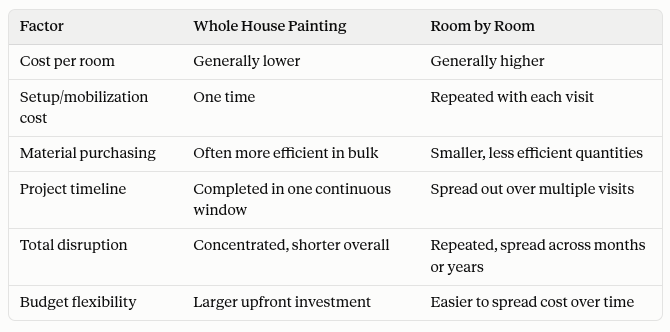
Setup and Mobilization Costs
This is the single biggest driver of the cost difference. A whole house project absorbs this cost once, while room-by-room painting repeats it with every visit, which adds up meaningfully over several projects.
Material Efficiency
Buying paint and supplies for a whole house project in coordinated quantities is typically more cost-effective than purchasing smaller amounts multiple times for individual rooms, especially when factoring in potential waste from leftover partial cans.
Timeline and Disruption
A whole house project concentrates disruption into one continuous window, while room-by-room painting spreads smaller disruptions out over a longer period, which some homeowners actually prefer depending on their household's needs.
Budget Flexibility
Room-by-room painting allows homeowners to spread the financial investment out over time, which can make sense for tighter budgets even if the total cost ends up somewhat higher than a single whole house project.
What to Avoid When Comparing Costs
Avoid comparing a single room's cost directly against a whole house quote without adjusting for setup costs
Avoid assuming room-by-room is always cheaper just because each individual payment is smaller
Avoid choosing a full whole house project purely for savings if you don't actually need every room painted
Avoid skipping a real cost comparison and just guessing based on assumptions about which approach is more affordable
Avoid ignoring the added disruption of repeated setup and teardown across multiple separate visits
Step-by-Step: Deciding Which Approach Fits Your Situation
List out how many rooms in your home actually need painting right now versus eventually
Get a free painting estimate for both a whole house approach and a room-by-room breakdown to compare directly
Factor in your available budget and whether a larger upfront cost or spread-out payments makes more sense
Consider your tolerance for disruption, one larger project versus several smaller ones over time
Ask your contractor to break down where the cost differences actually come from, setup, materials, or labor
Make your decision based on total value over time, not just the size of each individual invoice
Common Mistakes Homeowners Make
Assuming room-by-room always saves money simply because each project feels smaller
Not asking for a direct cost comparison between both approaches before deciding
Underestimating how disruptive repeated painting visits can be over an extended period
Choosing whole house painting without confirming every room actually needs it
Overlooking material waste that comes from purchasing paint in smaller quantities multiple times
Practical Tips for Getting the Best Value
Ask for an itemized estimate for both approaches so you can see exactly where the cost differences come from
If most of your home will eventually need painting, ask whether bundling now offers meaningful savings over spreading it out
Keep a running list of rooms you're considering for future projects, since this can help a contractor plan more efficient scheduling even if you're not ready for a full whole house project yet
If you're unsure how to prepare for either approach, reviewing a proper pre-painting checklist can help you get organized regardless of which option you choose
If you're leaning toward a full whole house project, it's worth understanding what a realistic schedule actually looks like before committing. This whole house painting timeline breakdown walks through what to expect day by day, which can help you weigh the time investment alongside the cost comparison. And once you've decided on your approach, this complete pre-painting checklist will help you prepare your home efficiently whether you're tackling one room or the whole house at once.
Frequently Asked Questions
Is whole house painting always cheaper than room-by-room in total?
Generally yes, per room, due to reduced setup costs and more efficient material purchasing, though the total upfront investment is larger since you're paying for the entire project at once rather than spreading it out.How much does setup and mobilization typically add to a room-by-room project?
It varies by contractor, but setup and teardown can represent a meaningful portion of a smaller project's total labor time, which is part of why repeated visits tend to cost more overall than one larger combined project.Can I start with room-by-room and switch to a whole house approach later?
Yes, this is common. Some homeowners paint priority rooms first and later decide to complete the rest of the home, though doing so means missing out on some of the cost efficiency a single combined project would have offered.Does room-by-room painting take longer overall than whole house painting?
When you add up the total time across multiple separate visits, room-by-room painting often takes longer in aggregate, even though each individual visit may be shorter than a whole house project.How can I get an accurate cost comparison for my specific home?
The most reliable way is requesting a detailed estimate for both approaches from the same contractor, so you're comparing real numbers based on your home's actual size and condition rather than general assumptions.
Conclusion
Whole house interior painting typically offers better value per room due to reduced setup costs and more efficient use of materials, while room-by-room painting offers more budget flexibility for homeowners not ready to tackle everything at once. The right choice ultimately depends on your specific goals, timeline, and budget. If you're weighing both options for your own home, ProVision Painting can provide a clear, itemized estimate for either approach so you can make the most informed decision. Reach out today for a free estimate.